
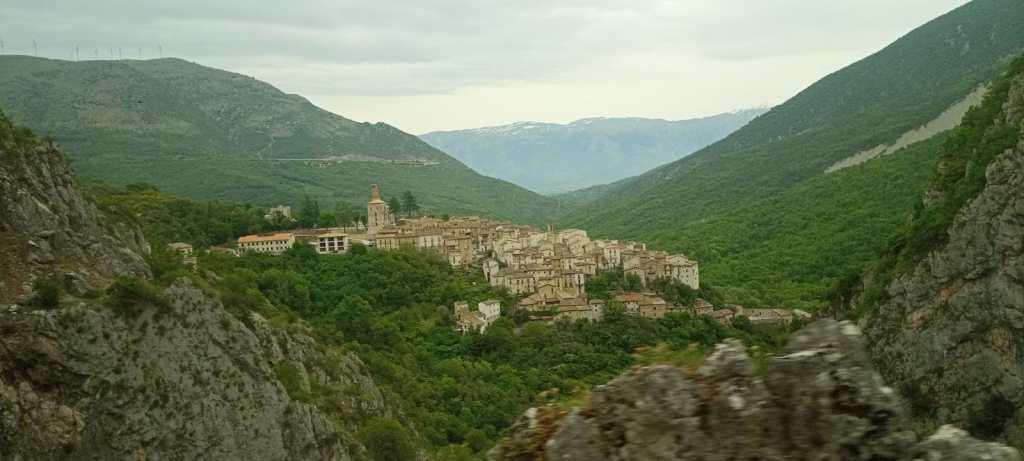
There are parts of Italy where festivals can feel polished for visitors, timed for cameras and packaged for easy consumption. Abruzzo feels different. The region itself presents many of its best-known rites as deeply participatory, heartfelt traditions, where myth, religion, memory and local identity remain closely bound together. That is why a journey through Abruzzo during festival season does not feel like event-hopping. It feels like entering a living cultural landscape.
Nowhere is that more striking than in Cocullo, home of the Festa dei Serpari, the famous snake-handlers’ festival held in honour of San Domenico. Each year, the saint’s statue is carried through the village covered in live snakes, while the serpari remain central figures in the ritual. Official and cultural sources link the festival to layers of belief that run from devotion to San Domenico back to much older associations with snakes and healing, including the ancient cult of Angitia, the serpent-linked deity of this part of central Italy. That mixture of Catholic ritual and much older symbolic memory gives Cocullo its singular power.
What makes Cocullo special is not simply the spectacle of snakes. In truth, that is the least interesting way to look at it. The festival is special because it expresses continuity. It speaks of protection, fear, reverence, springtime, survival and belonging. The snakes used are non-venomous and are released afterwards, but the deeper point is that this is a ritual still held by a community that understands its own symbols. Cocullo even has an ethnographic civic museum dedicated to the Serpari rite, which says a great deal about how the festival is preserved as local memory rather than reduced to a passing curiosity.
Cocullo may be the most unusual, but it is part of a much wider Abruzzese world of tradition. In Sulmona, Easter Sunday brings La Madonna che Scappa in Piazza, one of the region’s most moving rites. The ceremony takes place in Piazza Garibaldi at midday, when the mourning Madonna, dressed in black, emerges and then, on seeing the risen Christ, sheds the dark cloak, reveals green beneath and rushes across the square. Doves are released and the town holds its breath. The ritual is centuries old and remains closely tied to the local confraternity that organises it. This is not passive pageantry. It is belief performed as public memory.
Then there is Chieti, where the Good Friday procession is often described as one of the oldest in Italy. The procession moves through the historic centre by torch and candlelight, accompanied by the Miserere, with confraternities, statues and symbols of the Passion shaping an atmosphere that is solemn rather than theatrical. Everything about it suggests depth and endurance. You are not watching a revival. You are witnessing a rite that has remained woven into civic and religious life for centuries.
In winter, Abruzzo turns again to ritual, this time through fire. In Fara Filiorum Petri, the Farchie of Sant’Antonio Abate light up January with huge bundles of reeds carried and burned in honour of the saint. Official regional sources connect the custom to a local miracle tradition dating to 1799, when the woods were said to have appeared as giant warriors of fire. Whether one approaches that story through faith, legend or folklore, the meaning is clear: the rite binds the village through shared effort, shared memory and a dramatic act of collective devotion.
Abruzzo’s ritual calendar is not confined to village festivals. In L’Aquila, the Perdonanza Celestiniana brings together faith, history and civic identity in one of the region’s most important annual celebrations. Rooted in the pardon granted by Pope Celestine V, it unfolds each year in late August and was inscribed on UNESCO’s Representative List of the Intangible Cultural Heritage of Humanity in 2019. UNESCO describes it not as a single ceremony but as a living set of rituals involving the city, the province and a traditional forgiveness route across multiple communities. That detail matters, because it shows how Abruzzo’s traditions do not belong to one square or one stage. They belong to territory, memory and shared participation.
Taken together, these festivals reveal why Abruzzo feels so culturally rich. They are not special because they are exotic. They are special because they still do something real for the people who keep them alive. They mark grief and joy. They ask for protection. They honour saints while carrying traces of older worlds. They give villages and towns a language for continuity. In Cocullo, that continuity takes the form of snakes and a saint. In Sulmona, it runs across a square. In Chieti, it moves to the sound of the Miserere. In Fara, it burns against the winter dark. In L’Aquila, it opens a path of forgiveness across a whole community.
That is the true gift of festival season in Abruzzo. It offers not entertainment first, but entry into a region that still treats tradition as a form of belonging. Tourism may arrive, of course, but it is not the reason these rites endure. They endure because people still carry them, sing them, light them, prepare them and believe that they matter. And that is exactly why they are worth travelling for.
 Off The Beaten Track Italy
Leave a comment