
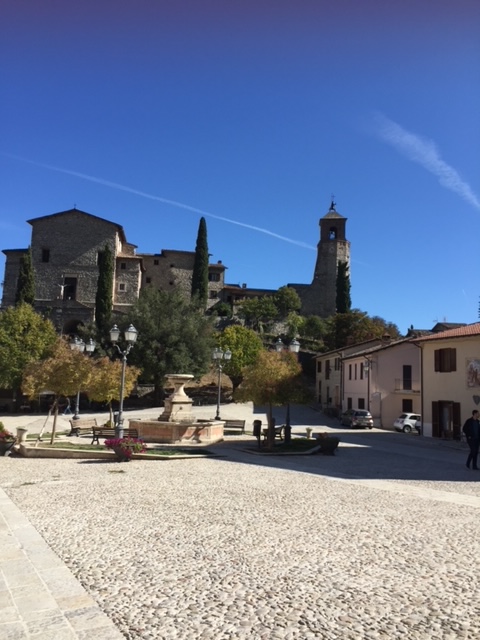
There are places in Italy that impress you immediately with grandeur, and then there are places that reach you more gently. Greccio, in Lazio’s Valle Santa near Rieti, belongs firmly to the second kind. It does not overwhelm. It settles around you slowly, through stone lanes, wooded slopes, silence, and the feeling that this is a place where people once came not to be entertained, but to reflect. Greccio is widely known because St Francis chose it in 1223 for the first living Nativity scene, and the sanctuary above the village still preserves that memory with remarkable power.
What struck me most about Greccio was its calm. Assisi is magnificent, of course, but Greccio offers something more intimate. It feels less visited, less formal, and somehow closer to the inner spirit of Francis. You walk through the village and up towards the sanctuary with a sense of stillness that seems entirely fitting for a saint who valued humility, simplicity and closeness to nature. This is not a place that performs spirituality for visitors. It simply carries it, quietly.
That may be why Greccio has such a strong emotional pull. According to official tourism sources, St Francis was deeply moved by the beauty of the place and its resemblance to Bethlehem. On Christmas Eve 1223, with papal authorisation and the help of Giovanni Velita, he recreated the Nativity in a cave here, establishing what is recognised as the first living Nativity scene in Christian history. The Sanctuary of Greccio, often described as the “Franciscan Bethlehem”, was later built around this sacred memory, with the Chapel of the Nativity forming its historic core.
The sanctuary itself clings dramatically to the rock, yet nothing about it feels severe. The stone, the cave, the chapel, the frescoes and the surrounding woods all work together to create an atmosphere of contemplation. Official descriptions note that the original Chapel of the Nativity was built in 1228, the year of St Francis’ canonisation, above the grotto where the Christmas re-enactment took place. When you stand there, the story of Greccio stops being just history. It becomes something felt.
Beyond the sanctuary, the village is lovely in its own right. Italia.it describes Greccio as one of Italy’s most beautiful villages, with a well-preserved medieval centre, castle remains, towers, and views across the Rieti Valley. It sits at around 700 metres above sea level and is surrounded by forest and holm oak woods, which adds to the sense of retreat. Walking here is part of the experience. You move through narrow streets and soft mountain light, and the wider landscape seems to invite you to slow down and breathe more deeply.
And then there is the pleasure of eating well after a reflective day. Greccio may be small, but it has some very appealing places to stop for lunch or dinner. The Comune di Greccio lists Ristorante Del Passeggero, Il Nido del Corvo, Hosteria Wine Bar Nonna Gilda, Taverna Frate Francesco and Bar Ristoro Praesepium among its local options. Tripadvisor’s current listings also highlight Il Nido del Corvo, Hotel Ristorante Della Fonte and Trattoria del Passeggero among the better-known choices. Local cuisine in the area includes Sabine specialities such as handmade tagliatelle with mushrooms or truffles, porchetta, cured meats and other hearty dishes that suit the landscape and the season.
I left Greccio feeling lighter. Not because it is dramatic or famous in the usual way, but because it offers something more rare: peace that feels authentic. It is a place where faith, landscape and history still seem to belong to one another. Even for those who are not on a religious journey, Greccio offers a day of unusual calm. For anyone seeking a deeper, quieter connection to the world of St Francis, this village in Lazio may say more than Assisi ever could, precisely because it speaks so softly.
 Off The Beaten Track Italy
Leave a comment