
When people think of Pisa, they usually think of one thing: the Leaning Tower. It is iconic, photogenic, and undeniably worth seeing. But to visit Pisa only for the tower is to miss the real pleasure of the city. In late March, when spring is just beginning to soften the air and the light feels gentler, Pisa reveals itself as a place made for wandering. It is a city that rewards curiosity. Step away from the crowds gathered around the famous square, and a quieter, more intimate Pisa begins to appear.
That is the Pisa I loved most.
Of course, there is always a certain thrill in seeing the tower in person. It stands there with all the familiarity of a place you have seen in photographs for years, and yet it still surprises you. But after the cameras, the guided groups, and the cheerful chaos of visitors posing with outstretched hands, I found myself wanting something else. I wanted to know what lay beyond the postcard version of the city.
The answer was simple: walk.
Pisa is a city best discovered on foot, without too much planning and without the pressure to tick off landmarks. Once I began to drift away from the main tourist routes, the atmosphere changed almost immediately. The streets felt calmer, the pace slower. Shuttered windows, faded facades, little corner shops and everyday cafés replaced souvenir stalls and queues. It was in those quieter streets that Pisa began to feel less like a destination and more like a living city.
There is something deeply satisfying about walking through a place where daily life is unfolding around you. In Pisa, this meant glimpses of residents chatting outside bakeries, students cycling past with great determination, and older locals lingering over coffee as though they had quietly mastered the art of time. The city has an ease about it once you let go of the idea that it must impress you instantly. Pisa does not reveal itself all at once. It asks you to notice.
And late March is a lovely moment to do just that. There is a freshness in the air, but enough warmth to sit outside with a coffee and watch the city move around you. The trees along the river are beginning to stir back to life, and the light on the buildings has that early spring clarity which makes even an ordinary street feel full of possibility.
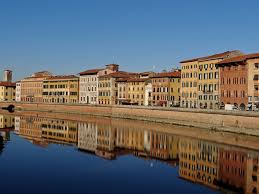
One of the most rewarding walks in Pisa is along the Arno. The river gives the city a quiet elegance. It is not dramatic in a showy way, but reflective, spacious and full of atmosphere. Walking beside it, you begin to understand the rhythm of Pisa differently. Bridges connect one side of the city to the other with such ease that you can simply cross whenever a street or a view invites you. The facades along the water, soft in colour and slightly worn by time, feel unmistakably Tuscan yet entirely their own.
It is by the Arno that Pisa seems to breathe most gently.
For travellers looking for a slow and quiet holiday, this is where Pisa truly comes into its own. It is a place for lingering in cafés rather than rushing between sights. It is a place for long lunches in neighbourhood restaurants, for choosing the side street over the obvious one, for ordering another espresso simply because there is nowhere else you need to be. The pleasure here is not in spectacle but in texture: the sound of footsteps on stone, the clink of cups, the hum of conversation, the shifting river light.
Pisa surprised me because it felt so much more human than expected. Beyond the tower lies a city that is thoughtful, understated and full of small discoveries. It may not demand your attention in the way some Italian cities do, but it earns it slowly, and perhaps more meaningfully because of that.
So yes, go and see the tower. But then keep walking. Follow the quieter streets, pause by the Arno, settle into a café, and let Pisa show you the life that exists beyond its most famous image. That is where the city becomes memorable.
 Off The Beaten Track Italy
Leave a comment